
Do fence me in
How constraints enhance creativity

It’s a misconception that creative expression only happens by exploring ideas in a free-floating space with limitless possibilities.
Sure, daydreaming can be valuable.
However, most artists need to start with some structure when faced with a blank canvas, an empty page, a musical instrument sitting next to them or a new project workspace in their music software program.
“Art consists of limitation. The most beautiful part of every picture is the frame.”
― G.K. Chesterton
Take it from the limit
Notable composer Stravinsky said that “whatever diminishes constraint, diminishes strength” as though the lack of something to push against makes us drift.
Paradoxically, the imposition of limits tends to expand creative possibilities. This makes sense cognitively as too many choices can lead to overwhelm, whereas narrowing options can help us be more focused.
To take advantage of this phenomenon, the choice of initial limits needs to be of sufficient rigour to get the creative muscles working.
Some constraints can occur easily and naturally. For example, an artist chooses a colour palette or a musician a chord progression—then these initial limits set the tone and pathway for further choices.

However, if songwriters for example gravitate to the same key or a similar set of chords, then their finished songs are likely to sound similar. This is not necessarily a bad thing; but if they want to break out of their usual patterns, imposing some more unfamiliar rules can be helpful, such as choosing a key very different to the ones they generally write in.
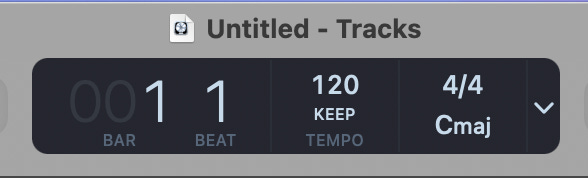
A post I saw on X recently made a disparaging remark about how so many contemporary songs were in the key of C and had a tempo of 120 bpm. I commented that opening a new project in Logic Pro defaults to these settings so that could be a contributing factor!
Composing with constraints and other creativity hacks
“Because the form is constrained, the idea springs forth more intensely.”
— Charles Baudelaire
Like the sound of a trumpet being the result of air being forced through a narrow tube, imposing boundaries on creative work can intensify focus.
David Bowie used various techniques to help with the songwriting process like chord restriction and generating lyrics from unrelated bits of text.
Brian Eno had Oblique Strategies1, originally a card-based method to encourage lateral thinking but now available in digital format such as apps and online generators such as this one.

Johann Sebastian Bach was a master of turning strict constraints into a vast creative output. His work, The Art of The Fugue, pushed counterpoint to its limits. Based on one foundational theme in D minor, he used a variety of techniques including inversion, augmentation and stretto (overlapping subjects) to create 18 works of increasing complexity2
Shakespeare wrote 154 sonnets under rigid constraints—including a 14 line limit, 10 syllables per line alternating stressed and unstressed and a specific rhyme scheme.
In modal jazz, exemplified by Miles Davis, chords are held for extended periods. This slow harmonic rhythm creates space and allows for more freedom in melody, phrasing and mood.
For an example of extreme time constraints, the name of the free jazz band, Instant Composers Pool3, is based on the concept that improvisation is “instant composition”.
How musicians can use constraints in composing and songwriting
Here are some suggestions on how setting limits in your creative work can spark new and original ideas:
Start with a less common key signature or time signature
Use a faster or slower tempo than you are used to
Compose on a different instrument, even if you are not proficient at it
Set a time limit to complete a song composition
On guitar, play and compose with an altered tuning
If you normally write from a chord progression, start with a melody instead, or vice versa
Use a random word or phrase generator like Oblique Strategies (or just open a book and point to a random place on a page) for ideas
If you generally only record demos with an accompaniment, record one with only an acoustic instrument
In electronic music, strictly limit the number of instruments/samples used
Sample sounds from the outside environment
Start with an unfamiliar genre or combine elements of two genres
Use collaboration to separate then combine roles e.g. melody/lyrics or different genres
Break the rules of the genre. For example, for a contemporary pop song, change keys or tempos within the song, change the chorus on each repeat or omit completely, compose a song that runs for 7 minutes

Choose to modify or break the rules of the constraints you set
Climbing wall image made with DiffusionBee
Artist paint palette, guitar player, note cards in the air and two songwriters images made via Canva
Jazz band image made via Microsoft Copilot
Em dashes are my own
https://en.wikipedia.org/wiki/The_Art_of_Fugue
https://en.wikipedia.org/wiki/Instant_Composers_Pool