
Parallel Times
Intervals and melodies in and out of style

At first thought, it’s hard to see what punk rockers and medieval maestros might have in common. But a basic building block of musical harmony underlies these seemingly disparate styles of music.
Powerful power chords
Containing just the bass note and fifth note of a chord, power chords are most commonly used in the punk genre and other types of rock music.
Used on their own, a progression of these stripped back chords can sound hollow, but when used with distortion, they produce a dense sound as additional harmonics are added. The use of distortion increases the complexity and richness of the sound by making the other harmonics become louder against the fundamental frequencies.
Voices in parallel
In medieval times, the unison voices in Gregorian chants were sometimes embellished by adding intervals of parallel fifths, fourths and octaves. These simple elements added resonance and heightened the grandeur of the performance.
In a similar way to power chords, the effect was to intensify the sound rather than produce a separate melodic line.

Gregorian chant was one of the earliest and most basic form of polyphony (the simultaneous playing of two or more tones or melodies).
In the Renaissance period there was a significant increase in musical complexity featuring more expressive melodies and structured harmonies. The development of music notation systems and the greater prominence of instruments also played a role in this evolution.
The practice of classical counterpoint — where polyphony developed into a compositional technique— emphasises the independence and distinctiveness of each musical line. This more complex style didn’t play well with perfect intervals.
Parallel fifths are so consonant that the frequencies blend into the one tone and the sound of individual notes is lost. And it can make it more difficult for a cappella voices to sing as the notes meld into each other—though the monks were obviously skilled at this.
Casting out the consonance
So composers largely banished the use of parallel fifths, or consecutive fifths, from around the Renaissance period through later periods of the Baroque, Classical, Romantic periods (together known as the Common Practice Period) and into the early 20th century.
The simpler sound of consonant intervals was seen as old-fashioned and unsophisticated compared to the richer, fuller sound of classical harmony.
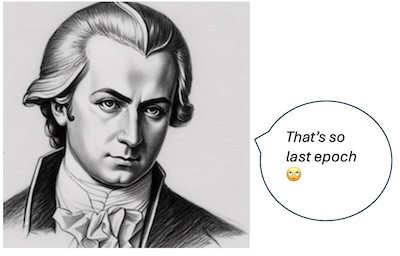
Classical composers didn’t always avoid parallel fifths as the independence of voices was not always the intention. In this piece by Edvard Grieg for example, the two parts of parallel fifths are clearly meant to imitate and reinforce the sound of ringing bells:
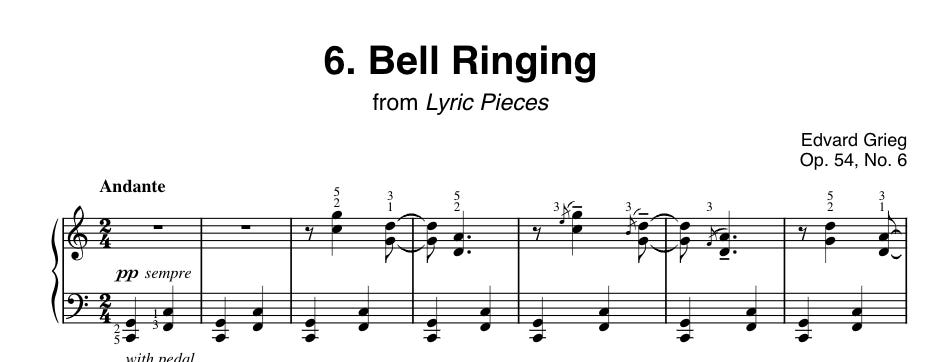
Today, the rules around parallel fifths have become less strict and these perfect intervals are often found in jazz music and film scores. Depending on the context, composers may avoid consecutive fifths, or employ them deliberately to create a particular sound.
Where has the melody gone?
Meanwhile, the melodic complexity we saw in centuries past is not generally echoed in today’s popular music. Classical music often featured key changes, or modulation, sometimes multiple times in longer pieces. However, this compositional technique is relatively rare in mainstream pop—although there was a period in the second half of the 20th century where it wasn’t uncommon to have a key change in a pop song.
Now, song structures tend to be simpler and more repetitive and there is more of a focus on rhythm, timbre and electronic production techniques rather than melody and harmonic changes.
So when Sabrina Carpenter makes a melodic variation of 3 semitones in one of her songs it causes quite a stir.
(Images, except for music score, made with DiffusionBee)